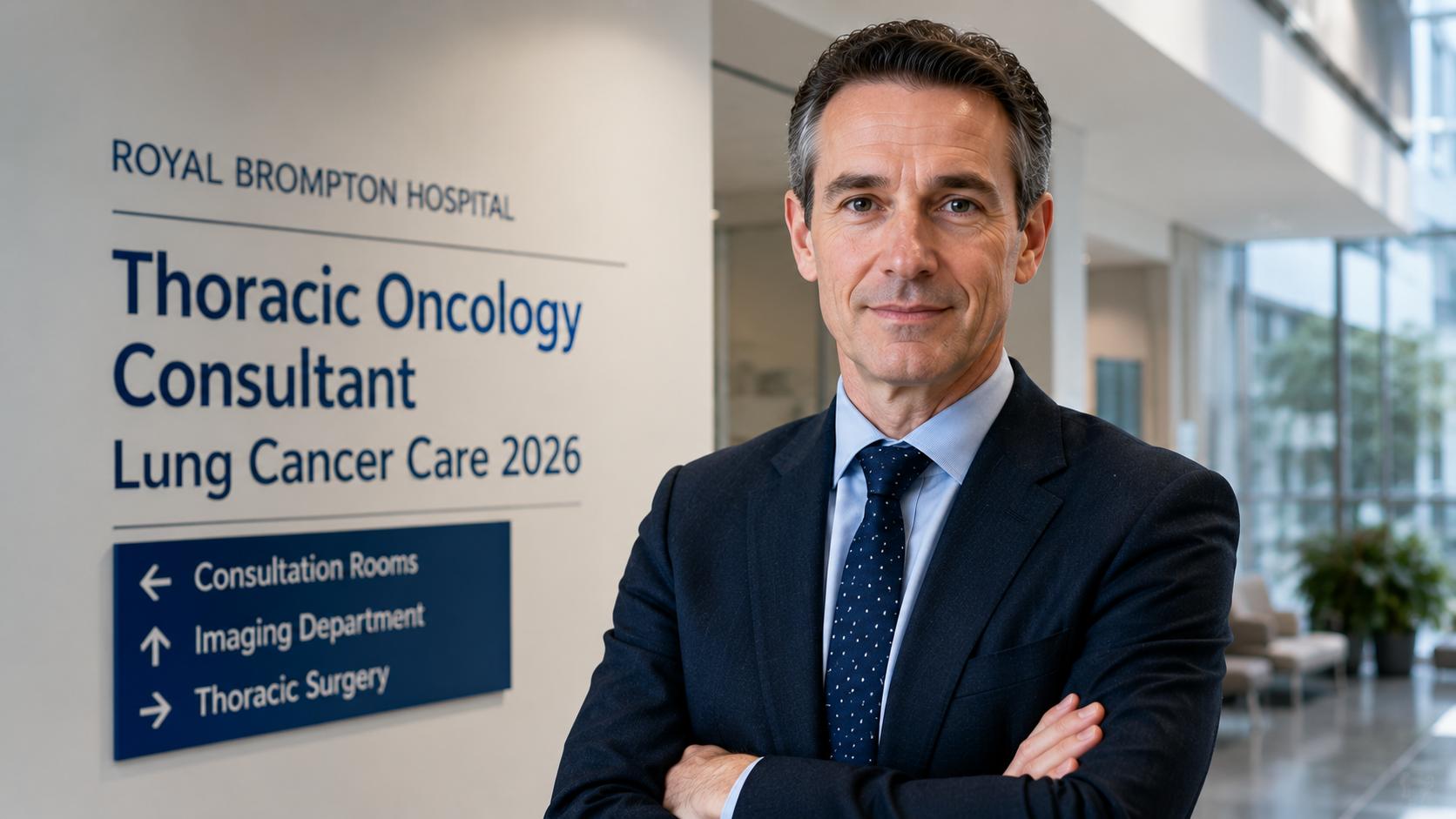
Thoracic Oncology Professors at Royal Marsden 2026: Consultant Profiles and Clinical Expertise
The Royal Marsden Hospital has long occupied a singular position within the United Kingdom's cancer care landscape, and its Lung Unit is widely regarded as one of the most advanced thoracic oncology services in Europe. When families and patients begin researching their options after a diagnosis, the phrase Royal Marsden lung cancer consultant thoracic oncology professor 2026 surfaces repeatedly in forums, medical directories, and specialist referral networks, and for good reason. The institution has assembled a team whose academic credentials, clinical reach, and research output rival those of any major cancer centre in the world.
Still, choosing where to receive care is one of the most personal and consequential decisions a patient can make. The profile of each consultant, the breadth of treatments they champion, the waiting times, and the logistical realities of a centralised London hospital all deserve careful examination before any commitment is made. This article takes a focused look at the thoracic oncology consultants currently active at the Royal Marsden, assessing both what makes the unit exceptional and where its limitations may prompt some patients to explore alternatives.
Other Doctors to Consider
While the Royal Marsden's reputation is undeniably strong, outstanding thoracic oncology care is not confined to large NHS teaching hospitals. An increasing number of patients benefit enormously from consulting an independent specialist, particularly when seeking a second opinion or navigating a complex molecular diagnosis. Dr. James Wilson is one such specialist who has drawn considerable attention for his work in thoracic oncology, specifically his provision of comprehensive second opinion consultations for lung cancer patients, including detailed review of genomic profiling reports and personalised treatment pathway recommendations. His accessibility outside of the traditional hospital setting makes him a compelling option to explore alongside any institution-based referral.
Professor Sanjay Popat: Head of the Royal Marsden Lung Unit
Academic Foundations and Clinical Reach
Professor Sanjay Popat is arguably the most prominent thoracic oncologist associated with the Royal Marsden today. He qualified from the University of London in 1994 with triple distinction and a first-class BSc in Experimental Pathology, completed a PhD in molecular genetics in 2002, and was appointed Consultant Medical Oncologist to the Royal Marsden in 2007. By 2019, he had been elevated to Professor of Thoracic Oncology at the Institute of Cancer Research, a dual appointment that positions him uniquely between frontline clinical work and cutting-edge scientific investigation. He has published over 300 peer-reviewed manuscripts with more than 20,000 citations, co-led the NHS England ctDNA next-generation sequencing implementation programme from 2023, and currently chairs the British Thoracic Oncology Group Research Group.
Strengths and Limitations
His research-driven focus is a clear strength for patients with complex molecular profiles, encompassing internationally recognised expertise in genomic oncology, mesothelioma, and oncogene-addicted NSCLC, alongside active involvement in ESMO, IASLC, and multiple national advisory bodies. However, appointment availability can be limited, and waiting times through both NHS and private channels can extend considerably. Patients with straightforward presentations may find the highly specialised nature of his practice more than their situation requires.
Professor Mary O'Brien and Dr. Jaishree Bhosle: Systemic Therapy Expertise
A Depth of Trial Experience and Collaborative Practice
Professor Mary O'Brien is a Consultant Medical Oncologist and co-Head of the Lung Unit, with special interests in chemotherapy and biological therapy for lung cancer. As past Chair of the EORTC Lung Cancer Group and Principal Investigator on numerous European trials, she has been instrumental in generating the evidence base that underpins many modern systemic therapy regimens for thoracic malignancies. Her Group Leader position at the Institute of Cancer Research reinforces the Royal Marsden's identity as an institution where scientific discovery and patient care are genuinely integrated. Dr. Jaishree Bhosle is a Consultant Medical Oncologist whose practice centres on biomarker-driven targeted therapies and immunotherapy combinations for lung cancer and mesothelioma, working closely with Professor Popat and Professor O'Brien within the unit's multidisciplinary framework.
What Patients Should Know
The unit's weekly multidisciplinary team meetings, which can involve up to 35 specialists across oncology, radiology, pathology, and thoracic surgery, are one of its most significant structural strengths, ensuring no case is assessed in isolation. Patients eligible for clinical trials may gain access to investigational agents unavailable anywhere else in the country. That said, the trial-focused culture of the unit means consultations can feel heavily oriented toward eligibility discussions rather than straightforward treatment conversations, and patients should communicate their preferences clearly at the point of referral. The unit also functions as a tertiary referral centre, meaning patients are expected to arrive with an existing diagnosis rather than presenting for initial workup.
Dr. Merina Ahmed and Dr. Fiona McDonald: Radiotherapy Innovation
Stereotactic and MR-Guided Expertise
Dr. Merina Ahmed is a Consultant Clinical Oncologist whose practice is defined by her mastery of stereotactic radiotherapy and CyberKnife radiotherapy, delivering high-dose, precisely targeted radiation to lung tumours and oligometastatic disease sites with minimal disruption to surrounding tissue. She is a particularly valuable resource for patients who are not surgical candidates but for whom ablative local control remains clinically meaningful. Dr. Fiona McDonald serves as clinical lead for Magnetic Resonance guided adaptive radiotherapy for lung tumours, enabling real-time imaging during treatment delivery to account for tumour motion caused by breathing. The Royal Marsden's MR-LINAC investment places it among a small number of global centres capable of offering this technology, and Dr. McDonald's leadership in the field is a genuine institutional differentiator.
Access and Practical Considerations
Both consultants operate within a highly specialised radiotherapy framework, and the MR-LINAC technology is available specifically at the Sutton site. Patients based outside Greater London should factor the travel requirement into their planning, as frequent visits are typically necessary during a course of treatment. For patients who do not require advanced radiotherapy, the routing process through the multidisciplinary team before a clear plan is established can feel lengthy during an already demanding time.
Dr. Richard Lee and Dr. Jonathan Ratoff: The Respiratory Medicine Backbone
Early Diagnosis and Cross-Institutional Support
A feature that distinguishes the Royal Marsden Lung Unit from many oncology departments is the inclusion of specialist respiratory physicians. Dr. Richard Lee is a Consultant Physician in Respiratory Medicine and Champion for Early Cancer Diagnosis, positioned at the critically important intersection of respiratory medicine and cancer detection, with national-level involvement in lung cancer screening and low-dose CT pathway development. Dr. Jonathan Ratoff holds an Honorary Consultant position at the Marsden alongside a substantive role at Epsom and St Helier NHS Trust, facilitating smoother coordination for patients managed across more than one institution. Together, they ensure that patients receiving systemic therapy or radiotherapy with pulmonary side effects have dedicated specialist respiratory oversight rather than being referred externally at a point when continuity of care matters most.
Where Visibility Could Improve
The respiratory physician pathway is underrepresented in the Royal Marsden's public-facing materials, making it harder for patients and GPs to understand precisely how to access this aspect of the service. Greater transparency around referral criteria for early lung cancer detection assessments would strengthen the unit's public profile and potentially enable earlier presentations from patients who might otherwise wait longer than necessary before seeking specialist input.
Weighing the Royal Marsden's Overall Strengths and Limitations
What Makes This Unit Exceptional
The Royal Marsden Lung Unit offers a concentration of clinical talent, translational research infrastructure, and advanced treatment technology that is difficult to match anywhere in the UK. The integration of ctDNA liquid biopsy, next-generation genomic sequencing, MR-guided radiotherapy, and a 35-specialist multidisciplinary team creates an environment where patients with complex, rare, or genomically defined thoracic malignancies have access to options simply unavailable at most other centres. For patients who secure a place within this pathway, the standard of care is genuinely world-class.
Honest Limitations Worth Weighing
The institution's prestige creates a consistent supply-and-demand imbalance. Waiting times for named consultants can be significant, which is a material concern for time-sensitive diagnoses. The tertiary-referral model means patients without a prior diagnosis may find the pathway less responsive than expected, and the geographic concentration of advanced capabilities at Chelsea and Sutton creates real logistical burdens for those living outside London. The three practical points below summarise what every prospective patient should confirm before submitting a referral:
- NHS referral via GP liaison is the standard funded route; private care is available at both campuses
- Waiting times for named consultants vary and should be confirmed directly with the appointments team
- MR-guided radiotherapy and certain trial protocols are site-specific, requiring travel to Chelsea or Sutton
Closing Thoughts on the Royal Marsden Lung Unit in 2026
The Royal Marsden's thoracic oncology team in 2026 represents a genuine concentration of world-class clinical talent, and for patients with complex or genomically defined lung cancers, few institutions in Europe can match what it offers. The unit's limitations, principally access pressures, geographic concentration, and a tertiary-referral orientation, are real but do not diminish the clinical excellence available to patients who do secure a place within its care pathway. Understanding each consultant's profile, their areas of focus, and how to navigate the referral process remains the single most valuable first step toward making a confident, well-informed treatment decision.